Expect 2 to 3 Years
In Phoenix, a car battery typically lasts 2 to 3 years, roughly half the 3-to-5-year lifespan expected in a milder climate.
At Phoenix Mobile Car Mechanic, we test and replace batteries across the Valley every week, where desert heat makes the usual national lifespan misleading. Phoenix batteries often fail sooner and with less warning, so knowing their likely lifespan, warning signs, and testing threshold can help you avoid a no-start.
In Phoenix, a car battery typically lasts 2 to 3 years, roughly half the 3-to-5-year lifespan expected in a milder climate.
Desert heat is the main driver, but short trips, parasitic electrical drain, and a failing alternator can shorten battery life even faster.
Have any battery over 3 years old load-tested before summer so measured cold cranking amps can be compared with its rated CCA.
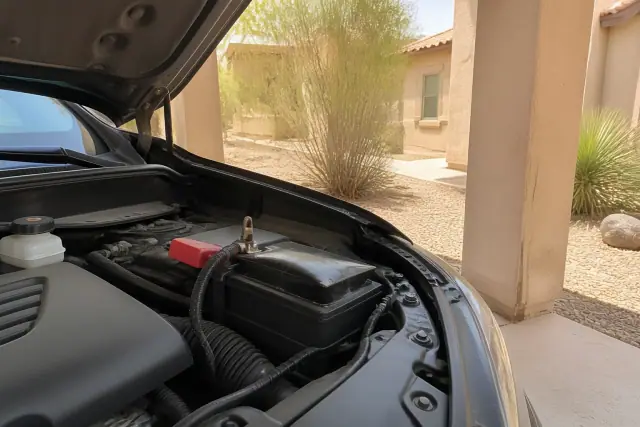
A swollen or misshapen case points to pressure from repeated heat cycling. It is a clear sign the battery needs prompt attention.
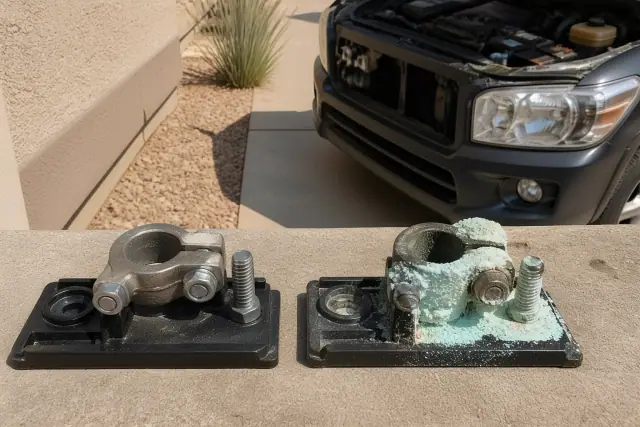
White or greenish crust on the terminals shows the corrosion that Phoenix heat and dust can accelerate. Clean, tight connections help preserve reliable starting.
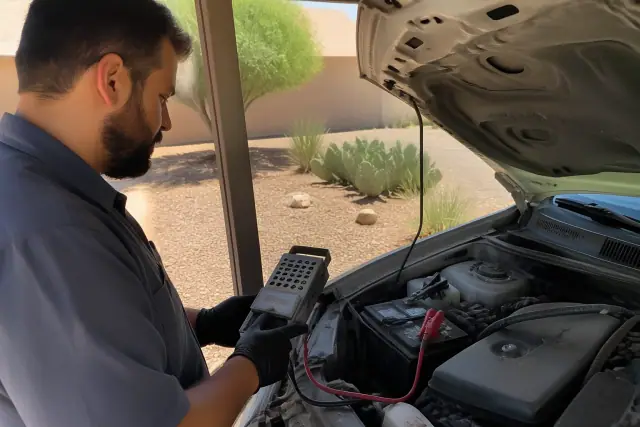
Testing both the battery and alternator separates a weak battery from a charging-system problem. That distinction helps prevent the wrong replacement.
Use a load test to compare actual cold cranking amps with the battery's rated CCA, then verify charging voltage.
Southern climates average around 2.8 to 3.5 years, and every 15°F rise above 77°F roughly doubles the internal chemical reaction rate.
Act when cranking slows, lights dim at idle, a charge light appears, the case swells, or the vehicle needs more than one jump start.
Avoid repeated jump-starting or an incorrect DIY terminal sequence; voltage spikes and short circuits can damage alternators or onboard electronics.
| Battery Age | Phoenix Context | Practical Action |
|---|---|---|
| 2 to 3 years | This is the typical local lifespan. | Watch for warning signs and test before summer. |
| Over 3 years | The battery is past the usual Phoenix range. | Get a load test even if it still starts normally. |
| Past 5 years | The battery is well beyond the expected local life. | Replace it regardless of current performance. |
A battery that fails in year two even though its label suggests five years may simply be reacting to Phoenix heat. A five-year-rated battery commonly delivers about three years here, while a straight replacement may be closer to two. That shorter life reflects faster plate corrosion and electrolyte loss, not necessarily a defective battery.
Maricopa County summer highs regularly pass 110°F, under-hood temperatures can exceed 200°F, and parking-lot pavement can top 150°F. Across a city of over 1.6 million residents and a metro near 5.19 million, many vehicles sit on unshaded asphalt for months at a stretch. Heat and dust accelerate terminal corrosion, while short trips leave batteries undercharged and dual-battery trucks can degrade unevenly.
What affects replacement cost? Group size, CCA rating, flooded lead-acid versus AGM construction, and dual-battery layouts determine where parts fall within the typical range. How long does mobile replacement take? Testing and on-site installation take about 20-30 minutes in a straightforward case. Can battery life be extended? Parking in shade or a garage, cleaning the terminals, and checking the charging system at every oil change are the most useful habits. Used lead-acid batteries require proper recycling in Arizona because they contain lead and sulfuric acid, as required by the Arizona Department of Environmental Quality.
Describe the vehicle, battery age, and warning signs. A mobile mechanic can test the battery and charging system where the vehicle sits, install a properly rated replacement, clean corrosion, secure the hold-down, and recycle the old lead-acid battery.