Proudly serving Phoenix, Glendale, Scottsdale, Tempe, Mesa, Chandler & surrounding areasCall or Text 24/7: 480-210-2603

Mobile Check Engine Light Diagnostics & OBD-II Fault Scanning in Phoenix, AZ

Phoenix Mobile Car Mechanic brings mobile check engine light diagnostics and auto repair to homes and workplaces throughout Phoenix. We diagnose warning lights with professional-grade OBD-II scan tools and can follow the findings with spark plug, ignition coil, sensor, radiator cooling system, alternator, starter, battery, brake, oil change, or AC repair service when needed. Our mobile service keeps drivers out of a waiting room while a technician evaluates the vehicle where it is parked. Customers receive a clear error code report before approving a repair.

Phoenix heat can expose oxygen sensors, wiring harnesses, ignition components, and cooling systems to sustained stress, especially during 110-plus degree days between May and September. A basic code reader names a stored condition, but it does not explain why the condition occurred. We compare live sensor data, freeze frame information, and manufacturer-specific code definitions to distinguish a failed component from a wiring, vacuum leak, or related system problem. That root-cause approach helps avoid replacing parts by guesswork.

Mobile diagnostics are practical in a city of 1.6 million residents spread across 517.9 square miles. If the light is flashing, stop driving and arrange a tow or mobile inspection because an active misfire can damage the catalytic converter within minutes.

Phoenix Mobile Car Mechanic provides mobile check engine light diagnostics in Phoenix, Scottsdale, Tempe, Mesa, Chandler, Glendale, and the greater Phoenix metropolitan area.

★ ★ ★ ★ ★4.9/5 Average Rating · 20+ Years of Experience · Thousands of Customers Helped · Licensed & Insured · Residential & Commercial

Mobile Check Engine Light Diagnostics & Benefits

What Are Professional Check Engine Light Diagnostics?

Professional diagnostics interpret why a trouble code appeared instead of treating the code as the name of a failed part. A parts-counter reader may reveal a number, while a technician compares the reported condition with the engine's actual behavior.

OBD-II trouble reporting follows SAE J1979 and J2012 standards, but manufacturers can define how a condition applies to a particular vehicle. We cross-reference stored codes with live data, freeze frame conditions, wiring behavior, vacuum integrity, and manufacturer specifications.

Each diagnostic session concludes with a printed or emailed report listing the code, its manufacturer definition, captured readings, and the recommended repair path. We explain the findings in plain language before you decide whether to proceed.

Benefits of Professional Diagnostics

A code-only guess can lead someone to replace a $40 sensor twice before finding the actual $200 problem. Thorough testing connects the warning light to evidence, reduces unnecessary parts purchases, and identifies secondary damage before a repair begins.

  • Stored trouble code retrieval
  • Live sensor data comparison
  • Freeze frame condition review
  • Bidirectional component testing
  • Manufacturer-specific code interpretation
  • Primary and secondary failure separation
  • Printed or emailed error code report
  • On-site testing at your home or workplace
Diagnostic Services

Check Engine Light Services

Our mobile diagnostic scope covers stored and pending codes, live engine data, intermittent faults, ignition misfires, emissions systems, and sensor performance. We work primarily with gasoline drivetrains and also review diesel and EV diagnostic requests as they arise.

OBD-II Code & Live Data Scanning

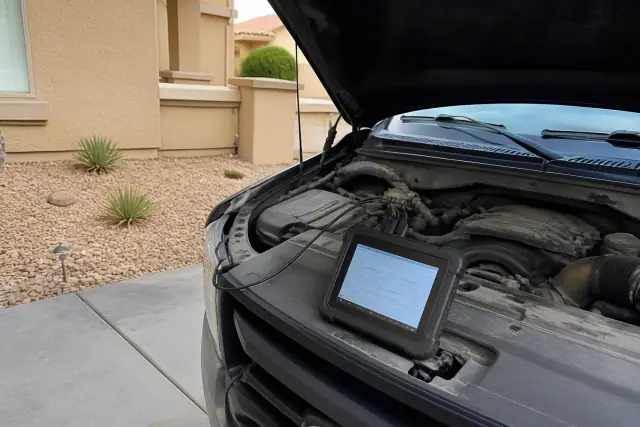
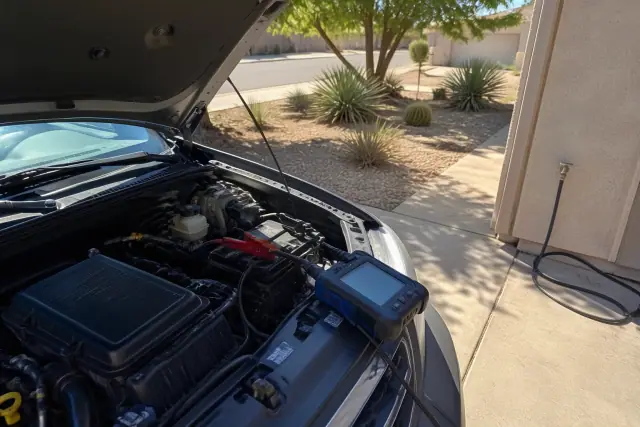
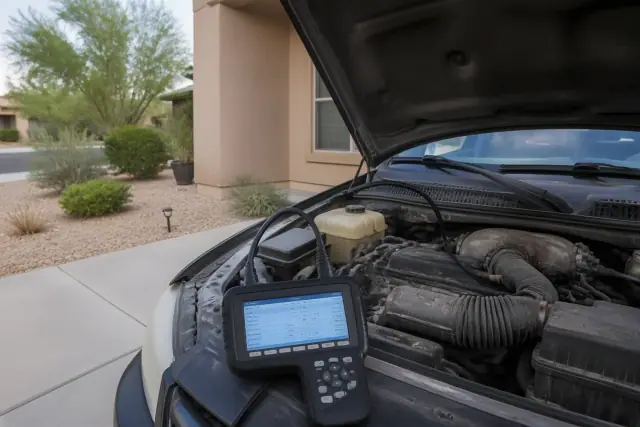
Diagnostic tablet showing OBD-II data on a car engine with the hood open at a residence in Phoenix, AZ.

We retrieve stored trouble codes and compare them with real-time fuel trims, oxygen sensor voltage, coolant temperature, and RPM stability. These readings show whether the condition is active and help narrow the fault beyond a generic lookup.

Request Estimate

Freeze Frame & Intermittent Fault Testing

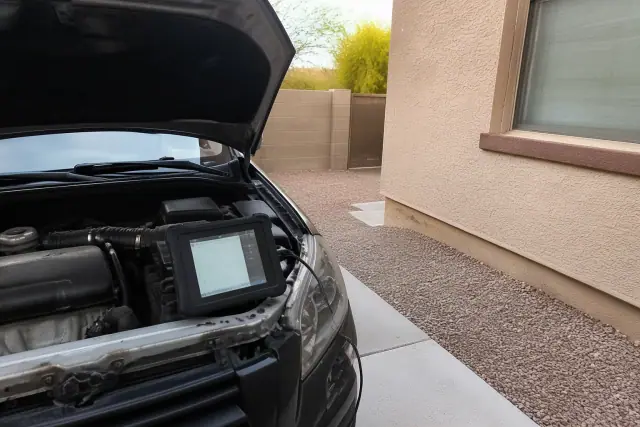
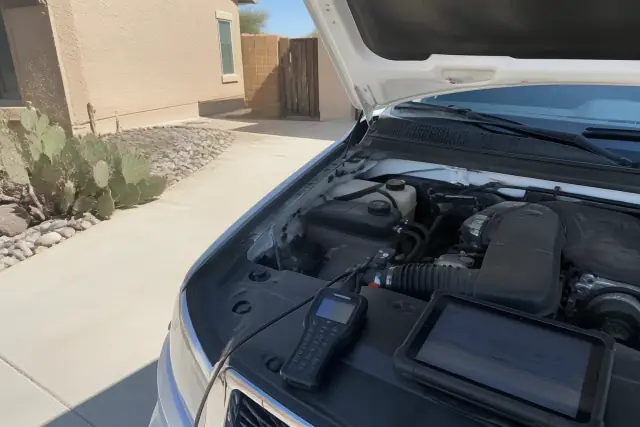
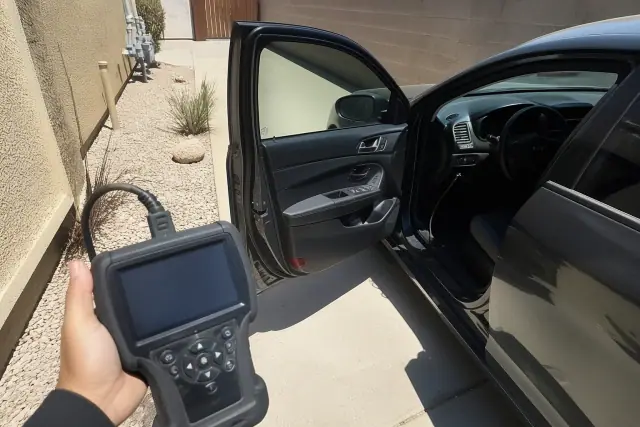
Technician performing check engine light diagnostics on a vehicle at a residential home in Phoenix, AZ.

Freeze frame data records the engine conditions present when a fault set. When a problem appears only on cold starts, under load, or during certain driving conditions, we can road test and rescan to reproduce it rather than clearing the light and guessing.

Request Estimate

Misfire & Ignition Diagnosis

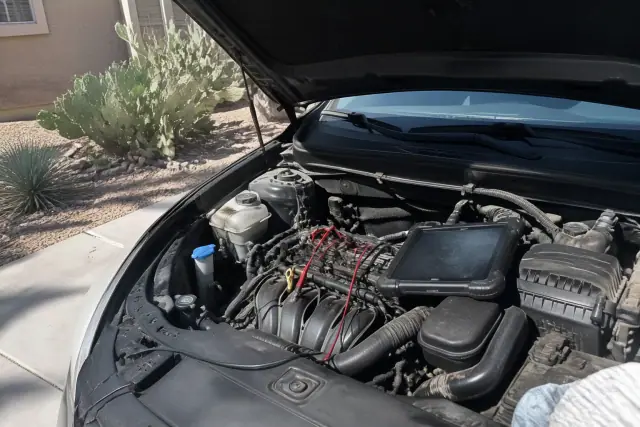
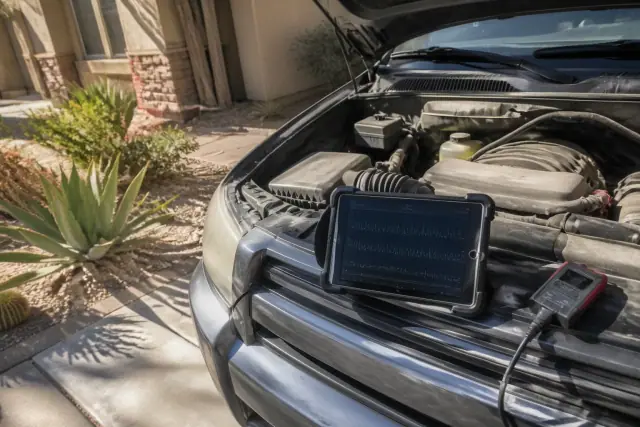
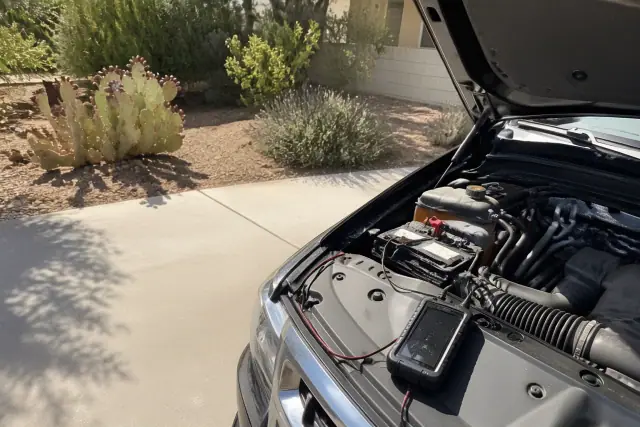
Open engine bay of a vehicle undergoing check engine light diagnostics in a Phoenix, AZ driveway.

P0300 and cylinder-specific codes such as P0301 and P0302 indicate detected combustion irregularities. We evaluate ignition coils, spark plugs, vacuum lines, and fuel delivery evidence to isolate the cause of a rough idle or flashing warning light.

Request Estimate

Emissions System Diagnosis

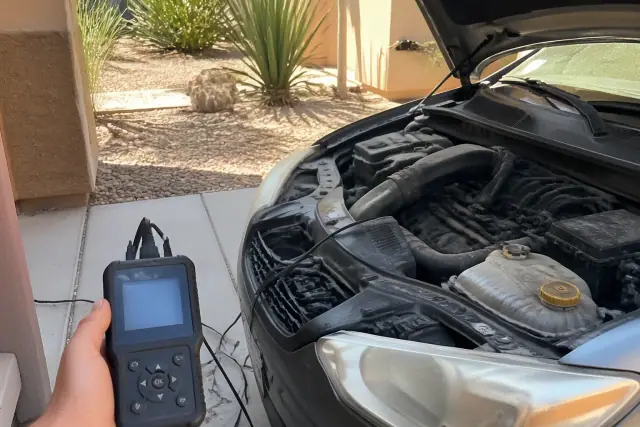
A technician performs an emissions system diagnosis on a vehicle engine in a residential driveway in Phoenix, AZ.

We interpret EGR faults such as P0400 and P0401, evaporative emissions codes from P0440 through P0457, and catalytic efficiency codes P0420 and P0430. Testing looks for the upstream misfire, fuel trim issue, seal, or component condition that caused the code before replacement is recommended.

Request Estimate

Sensor Performance Testing

Technician using a diagnostic tool to test engine sensors on a car in a Phoenix, AZ residential driveway.

Oxygen sensors, mass airflow sensors, and coolant temperature sensors can all trigger warning lights and drivability problems. We compare their live readings with expected values so a contamination, wiring, or vacuum issue is not mistaken for a failed sensor.

Request Estimate

Root-Cause Repair Recommendations

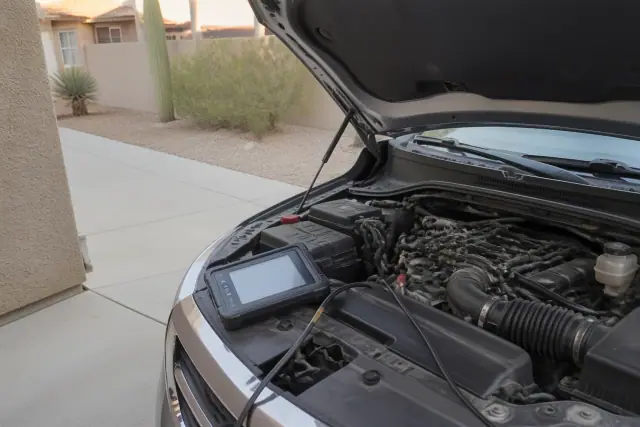
A car with its hood raised during a check engine light diagnostic in a residential driveway in Phoenix, AZ.

The final report separates the primary failure from secondary damage and connects each recommendation to a trouble code or measured value. Depending on the findings, the repair may involve a gas cap, sensor, ignition coil, spark plug, cooling system component, alternator, starter, or another supported mobile repair.

Request Estimate
Diagnostic Methods

Check Engine Light Diagnostic Methods

A complete diagnosis may combine several kinds of evidence. The right mix depends on whether the code is stored or active, the symptoms are constant or intermittent, and the vehicle requires manufacturer-specific definitions or control tests.

OBD-II scanner and tablet diagnosing a car engine in a residential driveway in Phoenix, AZ.

Stored Trouble Code Analysis

OBD-II ports became standard on gasoline and diesel vehicles sold in the United States beginning in 1996. Stored codes identify the circuit, sensor range, or system threshold that registered a fault, providing a starting point rather than a final parts list.

  • Stored and pending fault retrieval
  • Manufacturer definition review
  • Circuit and system identification
  • Related-code comparison
  • Code history documentation
Request Estimate
A mechanic using a handheld diagnostic scanner on a car engine in a residential driveway in Phoenix, AZ.

Live Sensor Data Analysis

Live data shows what the engine management system is reporting while the vehicle runs. Comparing multiple readings helps determine whether a component is actually failing or reacting to a problem elsewhere.

  • Short- and long-term fuel trims
  • Oxygen sensor voltage
  • Coolant temperature readings
  • Mass airflow values
  • RPM stability
Request Estimate
Diagnostic scan tool connected to a vehicle with an open hood in a Phoenix, AZ driveway.

Freeze Frame Review

Freeze frame information captures conditions at the moment a fault occurred. It can reveal whether the engine was cold, warm, idling, or under load and guide the next test for a problem that is not present at the appointment.

  • Engine operating condition
  • Vehicle load at fault
  • Temperature at fault
  • Fuel system status
  • Intermittent symptom clues
Request Estimate
Technician using a handheld diagnostic scanner on a vehicle in a Phoenix, AZ utility area.

Bidirectional Control Testing

A bidirectional scan tool can command supported components and confirm whether they respond. Cycling a cooling fan or firing an injector provides direct evidence that a circuit and component can perform the requested action.

  • Cooling fan command
  • Injector response test
  • Component actuation check
  • Circuit response confirmation
  • Code-to-component verification
Request Estimate
Car hood raised for an engine diagnostic scan on a concrete driveway in Phoenix, AZ with desert landscaping.

Road Test & Repeat Scanning

Intermittent faults may require changing driving conditions before the cause appears. When needed, we road test, clear codes after a repair, and rescan to verify that the underlying condition is resolved rather than merely hiding the light.

  • Cold-start symptom reproduction
  • Under-load monitoring
  • Stoplight idle evaluation
  • Post-repair code clearing
  • Confirmation rescan
Request Estimate
Finding the Root Cause

Choosing the Right Diagnostic Approach

The right approach depends on whether the light is steady or flashing, whether the symptom can be reproduced, and whether the vehicle requires manufacturer-specific software. A flashing light calls for an immediate stop, while a steady light generally allows careful driving only until it can be checked. Skipping a $150 diagnostic to avoid an upfront fee can result in buying a $400 part that was never the actual problem.

Professional OBD-II Tools

Our scan tools retrieve live data streams and freeze frame information and support bidirectional control tests. That depth lets the technician test an explanation against vehicle behavior rather than stop at a generic code description.

Clear Error Code Reports

You receive a printed or emailed report with the stored code, manufacturer definition, captured readings, and repair recommendation. We can explain what codes such as P0171 or P0455 mean for the specific vehicle before you authorize work.

Upfront Flat-Rate Pricing

We quote a flat diagnostic fee before arriving, so there is no open-ended labor clock while the fault is traced. When you approve the recommended repair, that diagnostic fee is credited toward the work.

What Sets Us Apart

Why Choose Phoenix Mobile Car Mechanic for Diagnostics?

We bring professional scanning and ASE-recognized diagnostic procedures to the vehicle, show the code and readings that support each recommendation, and explain primary versus secondary damage. The combination of on-site service, clear reporting, and upfront pricing gives you useful evidence before money is spent on parts.

Schedule Diagnostics

Flashing Check Engine Light

A flashing light indicates an active misfire that can send unburned fuel into the exhaust and destroy a catalytic converter. Because converter replacement can run into thousands of dollars, stop driving and arrange a tow or mobile mechanic rather than continuing the trip.

Rough Idle & Misfire

A rough idle paired with a warning light often points toward ignition or fuel delivery. Heat-degraded coils, worn spark plugs, and vacuum leaks in aging rubber lines are among the conditions we test on Phoenix vehicles.

Poor Fuel Economy

A failing oxygen sensor can disrupt the air-fuel mixture, while a contaminated mass airflow sensor can report the wrong air volume. Live-data comparison shows whether those readings align with the engine's actual operating conditions.

Hesitation on Acceleration

Hesitation under throttle can develop when mass airflow readings, fuel delivery, or ignition performance are unstable. A road test under load can expose a fault that does not appear while the vehicle idles in a driveway.

Emissions Test Failure

An illuminated check engine light results in an automatic failure under the Maricopa County vehicle emissions program administered through the Arizona Department of Environmental Quality. The stored fault must be diagnosed and repaired before the vehicle can pass testing.

Light Returns After Reset

Clearing a trouble code does not correct the condition that triggered it. Most unresolved codes return within a few drive cycles, which is why we rescan after repair and verify the underlying fault instead of treating a reset as a fix.

How It Works

Our Mobile Diagnostic Process

A straightforward code diagnosis typically takes 30 to 60 minutes, while intermittent faults may require additional driving or monitoring. Each step moves from the stored condition to current vehicle evidence and a clearly explained repair path.

01.

Connect the OBD-II Scan Tool

We connect a professional scan tool to the vehicle's OBD-II port and confirm communication with the engine management system. This establishes which modules and data streams are available for testing.

02.

Retrieve Codes & Freeze Frame Data

Stored codes identify the reported condition, while freeze frame data shows what the vehicle was doing when it occurred. We preserve those clues before clearing or changing anything.

03.

Analyze Live Data

We compare current fuel trims, oxygen sensor voltage, temperature, airflow, and engine-speed stability with expected behavior. This distinguishes an active fault from an old code and helps narrow the responsible system.

04.

Run Targeted Tests

When supported, bidirectional commands test whether a fan, injector, or other component responds. Circuit checks and manufacturer-specific definitions help determine whether the issue is the component, its wiring, or another condition influencing the reading.

05.

Road Test & Rescan

If the symptom is intermittent or appears under load, we may road test to reproduce it. After a repair, a repeat scan confirms whether the fault stays resolved under the conditions that originally triggered it.

06.

Explain Findings & Repair Path

We walk through the code, captured readings, primary failure, possible secondary damage, and recommended fix. You see the evidence and the flat-rate repair recommendation before authorizing work.

Mobile Diagnostic Help

Schedule Mobile
Check Engine Light
Diagnostics

Have the warning light diagnosed at your Phoenix-area home or workplace before buying parts or risking further damage. Call Phoenix Mobile Car Mechanic or request an appointment to receive an upfront diagnostic quote and a clear explanation of the results.

Diagnostic Help

Check Engine Light Diagnostic FAQs

These answers cover diagnostic cost, warning-light urgency, OBD-II testing, Phoenix-area emissions requirements, and what happens after we identify the fault. Call if your vehicle's symptoms or warning-light behavior do not fit these general examples.

Call for Diagnostics

Phoenix-area shops commonly charge between $150 and $250, while independent estimators show ranges around $143 to $210 depending on the vehicle and diagnostic complexity. Phoenix Mobile Car Mechanic quotes a flat fee before arriving and credits it toward the repair when you proceed with the recommended work. European and luxury vehicles may require manufacturer-specific software and longer procedures.

Some auto parts retailers provide a no-charge basic code scan for vehicles from 1996 or newer. That service usually retrieves a stored number but does not include live-data analysis, freeze frame interpretation, bidirectional tests, or root-cause diagnosis by a technician.

Some retailers offer complimentary scans that can detect a stored check engine, ABS, or maintenance code. The scan is a useful starting point, but it does not provide live-data interpretation, bidirectional testing, or a technician's diagnosis of why the code set on your specific vehicle.

Yes. Phoenix Mobile Car Mechanic performs on-site OBD-II scans with stored-code retrieval, live sensor data, freeze frame review, and supported bidirectional control tests. Those tools help confirm whether a component is failing instead of treating the code alone as a parts recommendation.

No. An illuminated check engine light causes an automatic failure under the Maricopa County emissions program administered through the Arizona Department of Environmental Quality, regardless of the stored code. Diagnose and repair the fault before the scheduled emissions test.

It depends on whether the light is steady or flashing and what fault is present. A steady light generally allows careful driving only until the vehicle can be checked, but a long trip risks compounding an unknown problem. A flashing light signals an active misfire, so stop driving and arrange a tow or mobile mechanic.

A straightforward session typically takes 30 to 60 minutes for code retrieval, live-data review, and initial interpretation. An intermittent fault may take longer if it requires a road test, changed operating conditions, or another scan to capture the problem.

A flashing light indicates an active misfire that may send unburned fuel into the exhaust. Continued driving can damage the catalytic converter within minutes, so stop the vehicle and arrange a tow or mobile diagnostic visit.

A professional scan can retrieve stored trouble codes, freeze frame conditions, and current data such as fuel trims, oxygen sensor voltage, coolant temperature, airflow, and RPM stability. Supported bidirectional tests can also command a component to confirm whether it responds.

Clearing a code resets the warning but does not repair the condition that triggered it. If the underlying sensor, ignition, emissions, wiring, vacuum, or cooling problem remains, the monitoring system usually detects it again within a handful of drive cycles.

P0300 indicates detected random or multiple-cylinder misfires rather than naming one failed part. Heat-degraded ignition coils, worn spark plugs, vacuum leaks in aging rubber lines, and fuel-delivery problems are among the conditions a technician should test before recommending a repair.

Yes. Phoenix Mobile Car Mechanic brings professional diagnostic equipment to homes and workplaces throughout Phoenix, Scottsdale, Tempe, Mesa, Chandler, Glendale, and the greater Phoenix metropolitan area. The vehicle can be scanned and evaluated where it is parked.

We provide a printed or emailed report with the code, manufacturer definition, captured readings, and recommended repair path, then explain the findings before you authorize work. If you proceed with the repair, the flat diagnostic fee is credited toward that work.